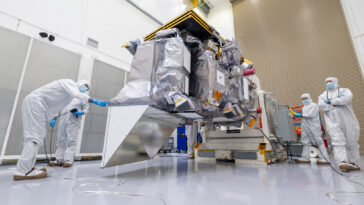
Artist concept of OSIRIS-REx. Image Credit: NASA/Goddard/University of Arizona
Three weeks after its asteroid target received a new name, NASA’s Origins-Spectral Interpretation Resource Identification Security Regolith Explorer (OSIRIS-REx) has officially passed a key confirmation review and has been authorized to proceed into the spacecraft development phase. If all goes well, the seven-year, $800 million mission to retrieve a small soil sample from the asteroid Bennu and return it to Earth for analysis will rise from the launch pad in September 2016.
EL SEGUNDO, Calif., May 16, 2013 — Boeing [NYSE: BA] has a new satellite customer under a contract to design and deliver one Boeing 702HP high-power spacecraft to ViaSat Inc. [NASDAQ: VSAT] in 2016.
Continue reading Boeing Selected to Build ViaSat-2 Satellite
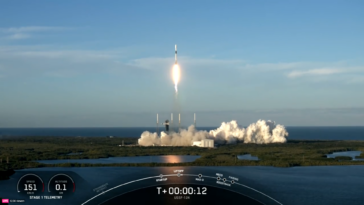
CAPE CANAVERAL, Fla — For those used to archival footage of the early days of space flight, watching modern-day launches must seem a tad dull. These days, launches are, by and large, happening on time and as planned. Such was the case with this past week’s launch of a United Launch Alliance Atlas V rocket with its GPS IIF-4 payload. Conducted for the U.S. Air Force, this launch took place under blue skies, with only a few contrails making their mark across the blue.
Continue reading Photo Feature: Launch of GPS IIF-4
NASA has announced that Launch Complex 39A will be open to take on commercial clients. Photo Credit: Julian Leek / Blue Sawtooth Studio
CAPE CANAVERAL, Fla — NASA is moving ahead with the space agency’s efforts to cede control of key structures and facilities as Kennedy Space Center in Florida. Through a synopsis released May 17, 2013, the agency plans to seek proposals for use of the historic location. NASA has said that it will be issued sometime next week.
Third graders from Lithia Springs Elementary show off their “Lithia Lynx Lander” at the Planetary Lander Egg Drop. Photo credit: Emily Carney/AmericaSpace.
DOVER, Fla — While it has been said, “Don’t put all your eggs in one basket,” and “Don’t count your chickens before they hatch,” 233 Florida students opted to not take that advice as they had their eyes on the prize—a single unbroken egg—Saturday, May 18, as they competed in the fourth annual Planetary Lander Egg Drop Competition at Strawberry Crest High School located in Dover, Fla.
Continue reading A Most ‘Egg-cellent’ Competition: Space Florida and Kennedy Space Center Host ‘Egg Drop’
NASA has used a camera on the Mars Reconnaissance Orbiter spacecraft to study how frequently the planet Mars is impacted by meteors. Image Credit: NASA / JPL
NASA’s Mars Reconnaissance Orbiter (MRO) has been kept busy counting the amount of impacts the Red Planet has to endure on a yearly basis. The number? More than 200 small asteroids or cometary debris collide with the planet’s surface annually. The craters formed measure at least 12.8 feet (3.9 meters) across.
Continue reading NASA Spacecraft Counts Impacts on Red Planet
With a cry of “We can fix anything,” the first crew heads toward Skylab on 25 May 1973. Since the launch pad was originally configured for the enormous Saturn V rocket, the smaller Saturn IB required a “pedestal” to raise its stages to the appropriate level for umbilicals and other utilities. Photo Credit: NASA
Four decades have now passed since one of the most dramatic reversals in fortune in American space history: the salvation of Skylab. On 14 May 1973, America’s first space station was launched into orbit atop the final Saturn V booster, but an unfortunate sequence of events led to the premature deployment of its micrometeoroid shield, which was promptly ripped away in the supersonic airstream, together with one of two solar arrays. The other solar array was so clogged with debris that it was “pinned” to the side of the station. For ten days, engineers battled to come up with a workable plan whereby Skylab’s first crew—astronauts Pete Conrad, Joe Kerwin, and Paul Weitz—could effect a successful repair and keep the crippled station on the straight and narrow.
Continue reading ‘With Flying Colours’: The Revival of Skylab
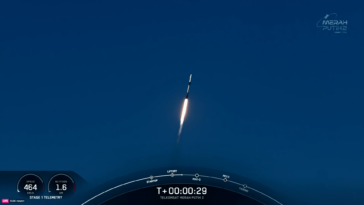
CAPE CANAVERAL, Fla — There could not have been clearer skies on May 15, 2013, at Cape Canaveral Air Force Station in Florida. The launch of an Atlas V 401 rocket with its GPS IIF-4 payload took place right on time and encountered zero obvious issues on the road to orbit. Representatives from both United Launch Alliance (ULA) and the United States Air Force consented to interview and detailed various elements of this mission. Every element of the operation was handled smoothly and efficiently. The daisy-chain of events that has to take place prior to lift-off occurred right on time. Culminating in the 70th launch in 77 months for ULA. Don’t take my word for it—check out the video above to see for yourself.
Want to keep up-to-date with all things space? Be sure to “Like” AmericaSpace on Facebook and follow us on Twitter:@AmericaSpace
NASA announced May 15 that a second reaction wheel on the Kepler spacecraft has failed. This is forcing officials at the space agency to reconsider what mission that space-based telescope is now capable of conducting. Kepler went into safe mode Tuesday. When controllers went about recovering Kepler, they discovered that one of the four reaction wheels was no longer operating.
Continue reading Reaction Wheel Failure Places Kepler Mission in Jeopardy
In what is being called the first music video recorded in space, Canadian astronaut Chris Hadfield posted his own version of David Bowie’s classic hit “Space Oddity“ (1969) on YouTube last Sunday. It was his last day as commander on the International Space Station, and he ended his stay there with style.
Continue reading Chris Hadfield Brings David Bowie’s ‘Space Oddity’ to the ISS
In Antarctica in January, 2013 – the summer at the South Pole – scientists released 20 balloons, each eight stories tall, into the air to help answer an enduring space weather question: when the giant radiation belts surrounding Earth lose material, where do the extra particles actually go? This NASA-funded mission is called BARREL, for Balloon Array for Radiation belt Relativistic Electron Losses. Each balloon launched by the BARREL team floated for anywhere from three to 40 days, measuring X-rays produced by fast-moving electrons high up in the atmosphere.BARREL works hand in hand with another NASA mission called the Van Allen Probes, which travels directly through the Van Allen radiation belts. The belts wax and wane over time in response to incoming energy and material from the sun, sometimes intensifying the radiation through which satellites orbiting Earth must travel. Scientists need to understand this process better, and even provide forecasts of such space weather, in order to protect our spacecraft.› Read MoreImage Credit: NASA Read More