



Week of January 18
The Orion spacecraft, consisting of the crew module, crew module adapter, and service module, that will fly four astronauts to the Moon on the Artemis II mission in the spring of 2025 is considerably advanced over its Artemis I sibling. The differences of the Artemis I and Artemis II Orion spacecraft are deep inside and outside the spacecraft.

To begin with, looking at images of the Artemis I and Artemis II Orion spacecraft, there are outward differences between the two spacecraft. Easily noticeable are two new instruments on the Artemis II Orion’s Crew Module Adapter (CMA)1. Highlighted in red is the Optical Communications System (O2O), the subject of this article.
Optical Communications System (O2O)
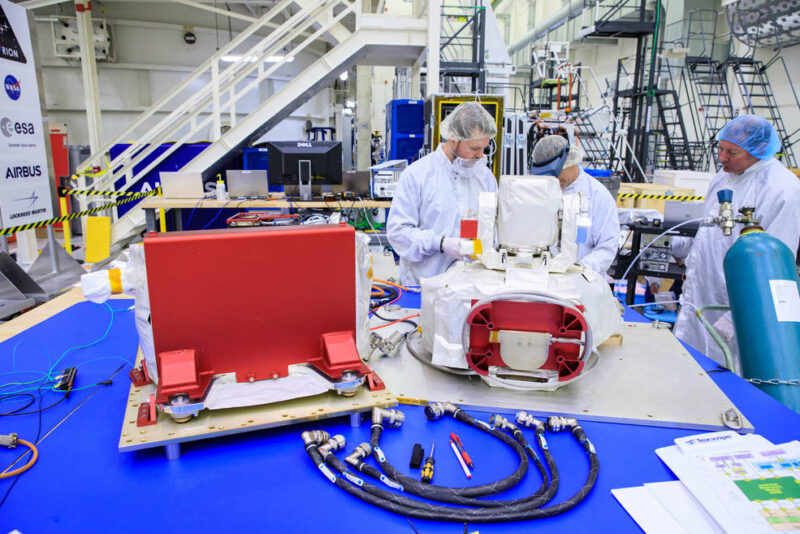
One of the new additions for Artemis II’s Orion spacecraft is the Optical Communications System O2O hardware, a DTO (detailed test objective) flying on Artemis II. The Optical Communications System2 is an infra-red laser based communications system that has been in development since 2013 by NASA in partnership with the Massachusetts Institute of Technology’s Lincoln Laboratory.
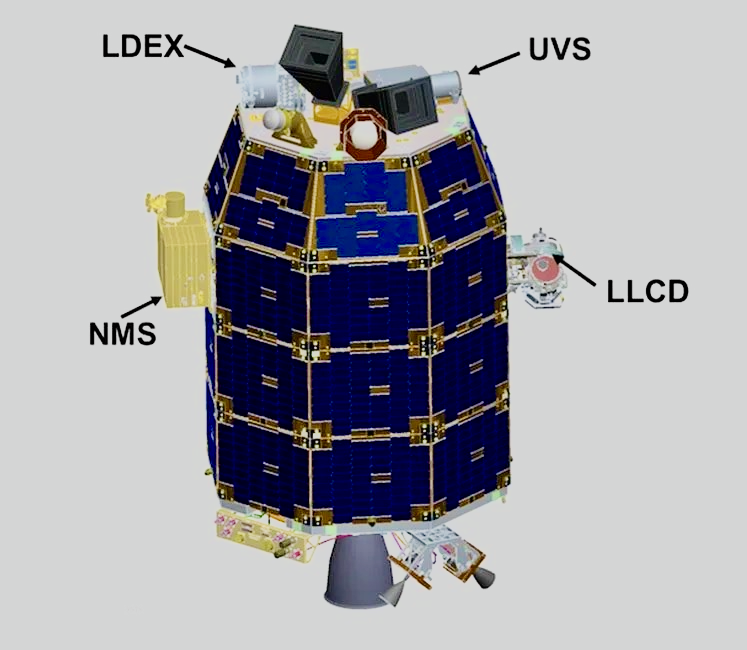
First light for NASA using a laser for two-way communications began in 2013 with the Lunar Laser Communications Demonstration3, a part of NASA’s Lunar Atmosphere and Dust Environment Explorer4 spacecraft that was to study the thin atmosphere of the Moon. MIT’s Lincoln Laboratory built the LLCD’s space and ground terminals. The LLCD mounted on LADEE consisted of a 10” (25 cm) cassegrain telescope with a solar rejection window that allowed the terminal to point right at the sun with no damage.
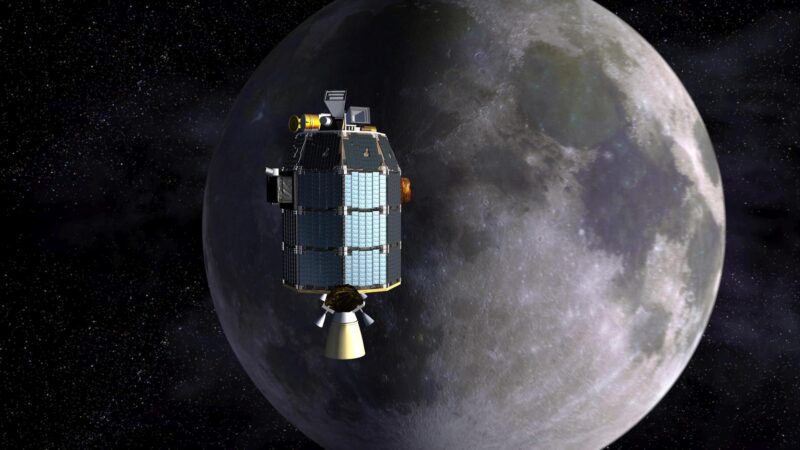
First light on October 17, 2013 was history making, with a demonstrated data transmission rate of 622 Mbps, which was 6 times higher than anything previously reached in the vast 239,000 miles (385,000 km) distance of the Moon and the receiving terminal in New Mexico. But equally historical was the 20 Mbps upload rate from the New Mexico ground station to the LLCD terminal on LADEE, which was 5,000 times faster than any earlier transmission to the Moon. Although LLCD wasn’t planned as more than a technological demonstrator, LLCD was so successful that on several occasions the LADEE spacecraft’s entire data buffer was downloaded in minutes5.
White radio signals have served well in their communications role since the dawn of space exploration, the LLCD on LADEE showed that laser offers the advantage of lower weight and size yet having much higher data transmission capabilities. The lessened weight and size penalty and additional power are allowing mission designers to game-out new sensors and data for deep space missions that would have been difficult or worse previously.
Once LLCD testing was finishing-up, NASA-Glenn was tasked with moving to the next step, the Laser Communications Relay Demonstration (LCRD).
LCRD is made-up of three components, a geosynchronous-orbit system based on an LLCD-like Lincoln Laboratory design, and two ground terminals. The LCRD geosynchronous orbiting satellite was launched on December 7, 2021 and now sits 22,000 miles above the surface of Earth. Since its launch, LCRD has been conducting experiments to refine laser communications in space. But it is only so useful as a relay when not being used to promote actual missions in space. Something was needed to take laser communications to the next level while making needed changes to compatible with LEO spacecraft.
As good as the design of the LLCD terminal on LADEE was, the design of LCRD needed to be updated due to limitations of LLCD. These updates made to the design of LCRD would improve its design for use with satellites in LEO. One limitation of LLCD was its “field of regard”, which is the direction in which the terminal can point the telescope when LCRD is within sight of the LEO satellite. Since a LEO satellite orbits at a velocity of over 17,000 mph (7.6 km/s), any laser terminal is going to have to move fast to stay locked-on between the LEO satellite and the geosynchronous LCRD relay satellite. The original LLCD terminal telescope design was limited to about 20 degrees of motion in the vertical and horizontal frames. A two-axis gimbal was added to the LCRD design that enabled better pointing through the horizon as a satellite moves through LEO. NASA also worked with industry to make the laser terminal, or telescope, more easily manufactured, resulting in MASsOT, the Modular, Agile, Scalable Optical Terminal[^footnote_6]. LEO was indeed the next step for NASA’s laser communications efforts.
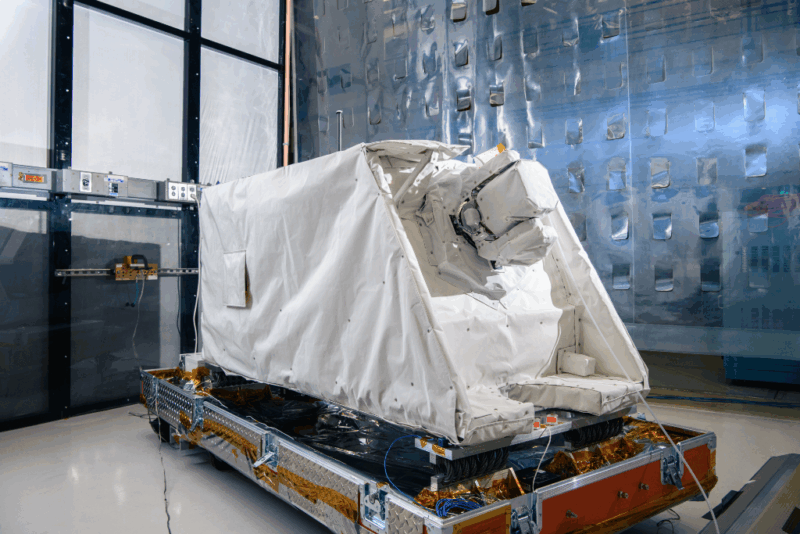
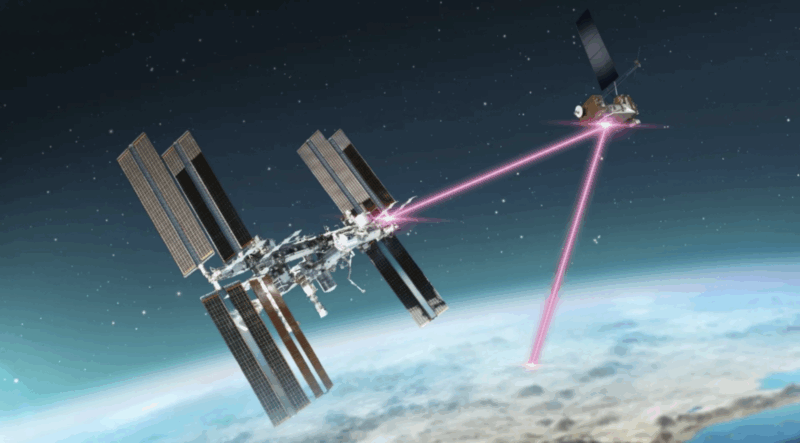
Now enter ILLUMA-T6. NASA’s ILLUMA-T (Integrated LCRD Low Earth Orbit User Modem and Amplifier Terminal) was launched to ISS on November 9, 2023 on Commercial Resupply 29 (CR-29). ILLUMINA-T , a partnership of MIT’s Lincoln Lab, NASA’s Communications and Navigation (SCaN), Goddard Space Flight Center, and Johnson Space Center, is the first demonstration of an end-to-end laser communications system. ILLUMINA-T is about the size of a house-hold refrigerator and is much more capable than LLCD, as one would expect given the march of technology.

Modem and Amplifier Terminal (ILLUMA-T) and NASA’s Hawaiian ground station. Image Credit: NASA
During testing on ISS, laser communications have shown a 2x to 6x improvement over radio frequency based communications in the amount of information that can be transmitted back to Earth, reaching transmission rates of up to 1.2 Gbps return and starting forward rates of 51-155 Mbps. But also important is the improvement in security that the use of a focused communications system allows. Simply put, RF signals from space are much harder to focus than a laser beam, making laser much tougher for others to tune-into compared to RF.
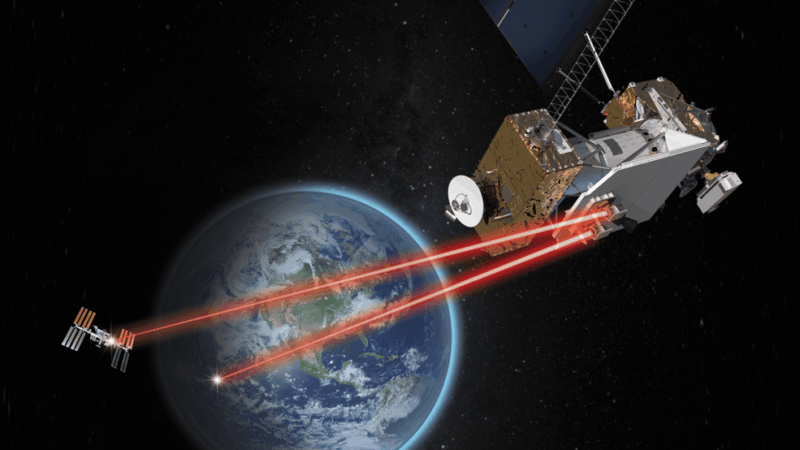
The Artemis II Orion spacecraft will carry its version of ILLUMINA-T, O2O will provide 260 Mbps transfer speeds allowing the Artemis II astronauts to share high resolution images and video from the Moon. O2O builds upon the successes of NASA’s 2021 Laser Communications Relay Demonstration, LCRD.
Footnotes:
- Orion crew module adapter (CMA) connects the Orion crew module to the service module. The crew module adapter houses electronic equipment for managing communications, power, and control, and includes an umbilical connector that bridges the electrical, data, and fluid systems between the main modules. It also is the mounting structure for the star trackers and now O2O. Source: Orion Components, NASA, February 26, 2024
↩︎ - NASA’s O2O Page ↩︎
- Lunar Laser Communications Demonstration (LLDC) ↩︎
- Lunar Atmosphere and Dust Explorer ↩︎
- Lighting Up The Speed Of Communications ↩︎
- ILLUMA-T launches to the International Space Station ↩︎


4 Comments
4 Pings & Trackbacks
Pingback:The Dark Side of the Moon – SUA SPONTE: Celebrating a decade of political musings from the fifth estate
Pingback:Artemis II Laser Communications: 4K Moon Video Tech
Pingback:Laser zamiast radia - jak NASA przesyła 4K z Księżyca - HELPO Network
Pingback:Laser O2O na Artemis II – 260 Mb/s z Księżyca | HELPO Network