Enter your email address to subscribe to AmericaSpace and receive notifications of new posts by email.

WGS-5 Launch to Mark Delta IV's Return to Flight

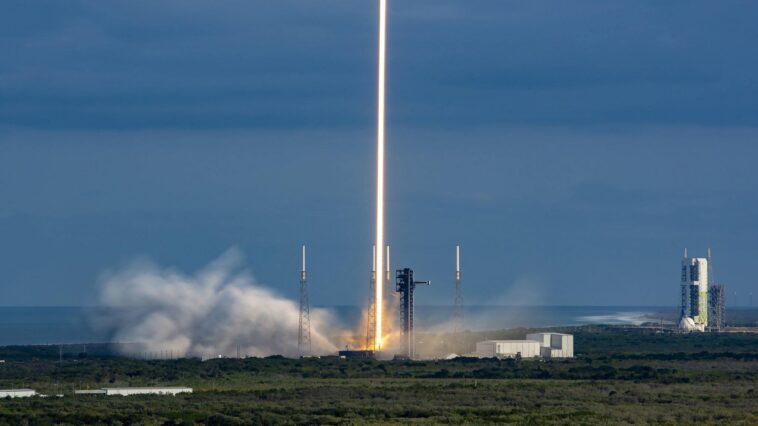
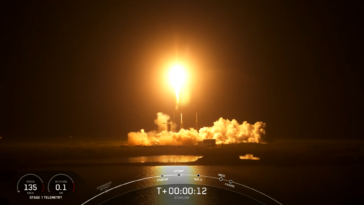
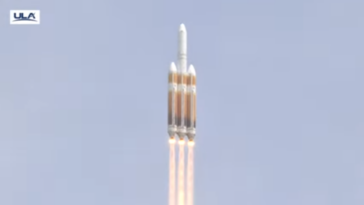
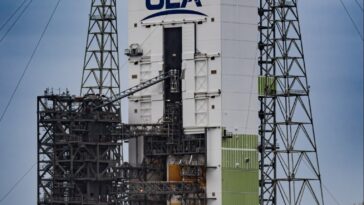
United Launch Alliance is currently planning to launch a Delta IV Medium rocket from Space Launch Complex 37 in Florida. Photo Credit: Jason Rhian / AmericaSpace

United Launch Alliance is currently planning to launch a Delta IV Medium+ 5,4 rocket from Space Launch Complex 37 in Florida. Photo Credit: Jason Rhian / AmericaSpace

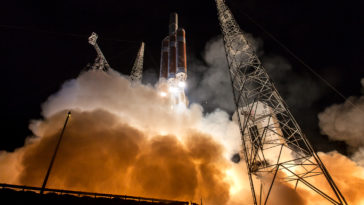
CAPE CANAVERAL, Fla — No sooner has the smoke and fire settled from last Wednesday’s liftoff of an Atlas V to deliver the GPS IIF-4 satellite into orbit, United Launch Alliance (ULA) is primed to rattle Cape Canaveral Air Force Station, Fla., again on Thursday, 23 May, with the roar of a Delta IV Medium booster from Space Launch Complex (SLC)-37. The mission will insert the fifth Wideband Global Satcom (WGS-5) into orbit on behalf of the U.S. Air Force. Originally scheduled to fly Wednesday, 22 May, a decision was made at the weekend to delay by 24 hours. “During acceptance testing for another mission,” explained ULA in a Sunday news release, “an avionics box that is used for controlling the Delta booster RS-68 engine experienced an anomaly.” As a result, ULA has replaced the box “with one that has been inspected and confirmed not to have the suspect condition.”

Continue reading WGS-5 Launch to Mark Delta IV’s Return to Flight

Launch Viewing Guide: Delta IV Medium (WGS-5)

United Launch Alliance is currently planning to launch a Delta IV Medium rocket from Space Launch Complex 37 in Florida. Photo Credit: Jeffrey J. Soulliere

United Launch Alliance is currently planning to launch a Delta IV Medium rocket from Space Launch Complex 37 in Florida. Photo Credit: Jeffrey J. Soulliere

CAPE CANAVERAL, Fla — Everything is moving ahead with a planned Thursday evening launch attempt of a United Launch Alliance (ULA) Delta-IV medium rocket from Cape Canaveral Air Force Station’s (CCAFS) Space Launch Complex 37.  The Wideband Global Satellite 5 (WGS-5) will be the payload for this mission. As long as weather and technical issues allow, the launch is scheduled to occur tomorrow at 8:26 p.m. EDT. Engineers have roughly 32 minutes to get the rocket off the pad before the close of the launch window at 8:58 p.m. EDT.

Continue reading Launch Viewing Guide: Delta IV Medium (WGS-5)

What Comes After Kepler?

The Kepler Space Telescope has had another of its reastion wheels fail, meaning the spacecraft's mission of finding Earth-like worlds - is probably over. Image Credit: NASA

The Kepler Space Telescope has had another of its reastion wheels fail, meaning the spacecraft’s mission of finding Earth-like worlds is probably over. Image Credit: NASA

Launched on March 7, 2009, NASA’s Kepler space telescope, designed to hunt for Earth-sized planets orbiting other stars, has proved to be an outstanding success and has surpassed its initial planned lifetime of 3.5 years. But the recent failure of one of its three remaining reaction wheels—a fourth had stopped working earlier—has put the mission in jeopardy. In fact, it’s quite possible that Kepler has made its last planet-seeking observation. So what comes next?

Continue reading What Comes After Kepler?

Retro Space Images: The Ascent of Apollo 10

The ascent stage of the Apollo 10 Lunar Module rises up from the Moon. Photo Credit:  John Young / NASA

AS10-34-5115 The ascent stage of the Apollo 10 Lunar Module rises up from the Moon. Photo Credit: John Young / NASA

Remembering Apollo 10 —  The Lunar Module “Snoopy” is shown in this rendezvous image taken by astronaut John Young aboard the Command  Module “Charlie Brown.” Astronauts Tom Stafford and Gene Cernan had just completed checking out the LM systems a final time, thus paving the way for a lunar landing by Apollo 11 two months later.

Like what you see? Then check out: Retro Space Images

Want to keep up-to-date with all things space? Be sure to “Like” AmericaSpace on Facebook and follow us on Twitter: @AmericaSpace

Continue reading Retro Space Images: The Ascent of Apollo 10

Atlantis Takes Flight at Kennedy Space Center Visitor Complex

Photo Credit: Julian Leek / Blue Sawtooth Studio

Photo Credit: Julian Leek / Blue Sawtooth Studio

KENNEDY SPACE CENTER, Fla — With less than a month to go before the doors open on what could be one of the most exciting space exhibits ever, Space Shuttle Atlantis is one step closer to being ready to make her grand entrance. This past week, at the Kennedy Space Center Visitor Complex in Florida, Atlantis’ payload bay doors were open; in doing so the concept behind the structure’s design was clearly validated.

Continue reading Atlantis Takes Flight at Kennedy Space Center Visitor Complex

Nine-Year-Old Mars Rover Passes 40-Year-Old Record

On the 3,309th Martian day, or sol, of its mission on Mars (May 15, 2013) NASA's Mars Exploration Rover Opportunity drove 263 feet (80 meters) southward along the western rim of Endeavour Crater. Image Credit: NASA/JPL-Caltech

On the 3,309th Martian day, or sol, of its mission on Mars (May 15, 2013), NASA’s Mars Exploration Rover Opportunity drove 263 feet (80 meters) southward along the western rim of Endeavour Crater. Image Credit: NASA/JPL-Caltech

PASADENA, Calif — While Apollo 17 astronauts Eugene Cernan and Harrison Schmitt visited Earth’s moon for three days in December 1972, they drove their mission’s Lunar Roving Vehicle 19.3 nautical miles (22.210 statute miles or 35.744 kilometers). That was the farthest total distance for any NASA vehicle driving on a world other than Earth until yesterday.

Continue reading Nine-Year-Old Mars Rover Passes 40-Year-Old Record

NASA Mars Rover Curiosity Drills Second Rock Target

NASA's Mars rover Curiosity drilled into this rock target, "Cumberland," during the 279th Martian day, or sol, of the rover's work on Mars (May 19, 2013) and collected a powdered sample of material from the rock's interior. Image credit: NASA/JPL-Caltech/MSSS

NASA’s Mars rover Curiosity drilled into this rock target, “Cumberland,” during the 279th Martian day, or sol, of the rover’s work on Mars (May 19, 2013) and collected a powdered sample of material from the rock’s interior. Image credit: NASA/JPL-Caltech/MSSS

PASADENA, Calif — NASA’s Mars rover Curiosity has used the drill on its robotic arm to collect a powdered sample from the interior of a rock called “Cumberland.”

Continue reading NASA Mars Rover Curiosity Drills Second Rock Target

NASA and the White House Pay Tribute to Sally Ride

Photo Credit: NASA

Photo Credit: NASA

WASHINGTON — NASA and President Obama are honoring the life and legacy of Sally Ride on the day a national tribute was held for the first American woman in space.
Continue reading NASA and the White House Pay Tribute to Sally Ride
Britain's Tim Peake Assigned to Six-Month ISS Mission in 2015-16

Pictured during training in an Extravehicular Mobility Unit (EMU) space suit, Tim Peake will be the first official British astronaut whose mission has been sanctioned and financed directly by the U.K. government. Photo Credit: NASA

Pictured during training in an Extravehicular Mobility Unit (EMU) space suit, Tim Peake will be the first official British astronaut whose mission has been sanctioned and financed directly by the U.K. government. Photo Credit: NASA

Four years after his selection as a European Space Agency (ESA) astronaut candidate, Britain’s Tim Peake has been formally named as a crewmember aboard Expedition 46/47 to the International Space Station. He will launch with Russian and U.S. crewmates aboard Soyuz TMA-19M in November 2015 and is expected to spend almost six months in orbit. Born in Chichester, England, Peake will not be the first Briton to enter space, but will be the first to officially represent the British government. News of Peake’s assignment was made public by the BBC and several U.K. publications Sunday, although the announcement from ESA was made Monday afternoon.

Continue reading Britain’s Tim Peake Assigned to Six-Month ISS Mission in 2015-16

As ATV Launch Approaches, Damage to Docking Sensor Still to be Assessed

View of the docking port on the Zvezda module marking the area potentially impacted by Progress M-19M in April 2013 Image Credit: Roscosmos/Anatoly Zak/Russianspaceweb.com

View of the docking port on the Zvezda module, marking the area potentially impacted by Progress M-19M in April 2013. Image Credit: Roscosmos/Anatoly Zak/Russianspaceweb.com

While the fourth European ATV has been sitting on top of an Ariane 5 launcher set for launch to the International Space Station (ISS) on June 5, engineers are still analyzing a potential problem with a Laser Radar Reflector (LRR) which allows ATV’s autonomous approach to the station. On April 26, Progress M-19M cargo docked at the ISS with one of its KURS rendezvous antennas folded, due to a failure in the deployment mechanism. One out of three LRR mounted around the Zvezda’s aft docking port happened to be in the way of the undeployed antenna. No strange noises or problems were reported, but concerns were expressed on possible damage to the delicate optical sensor.

Continue reading As ATV Launch Approaches, Damage to Docking Sensor Still to be Assessed