



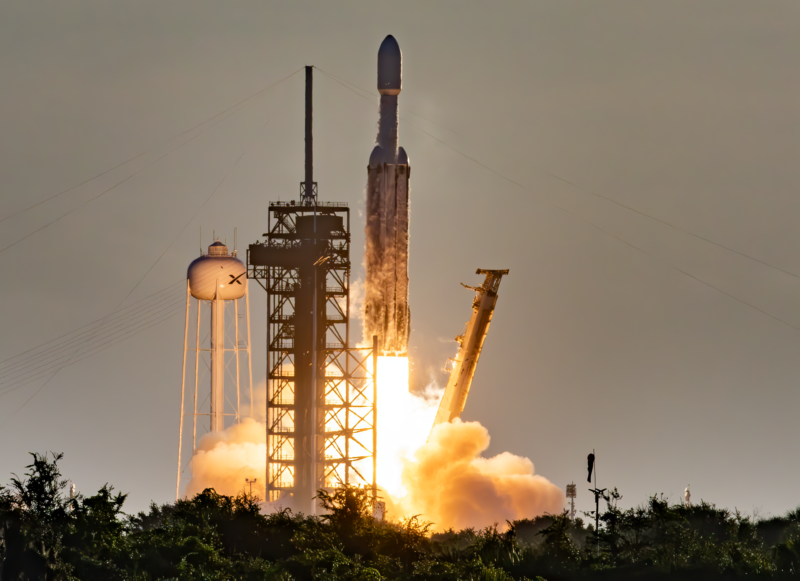
The Nancy Grace Roman Telescope mission launched successfully at the first window opportunity on August 30, 2026 from Launch Complex 39A of the John F Kennedy Space Center. Shortly after launch, the solar panels were deployed and the satellite was powered on. Later, as more instruments and devices are powered on and as the telescope comes to life, testing will be started. In approximately 3 months the crafts trajectory will bring Roman to the Sun–Earth Lagrange Point 2 (L2). By this time, the Telescope should be well into the testing and instrument calibration phase. Possibly the first science observations may be available before the end of 2026, if things go to schedule.
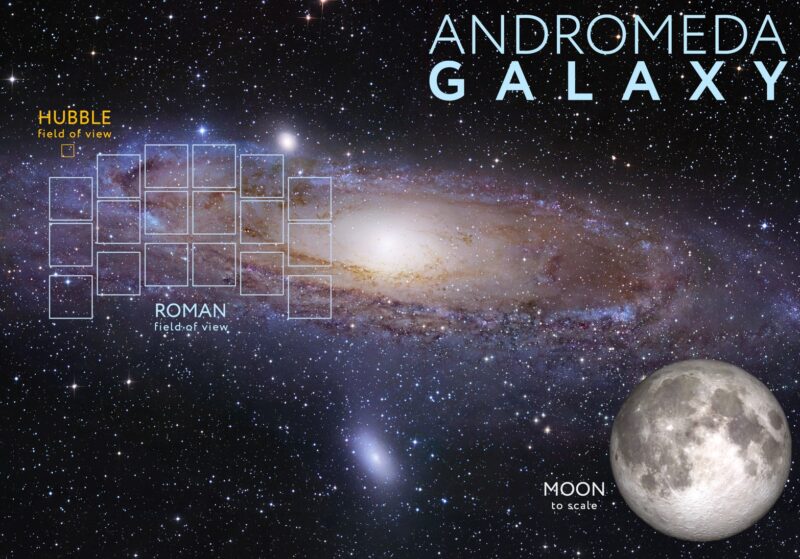
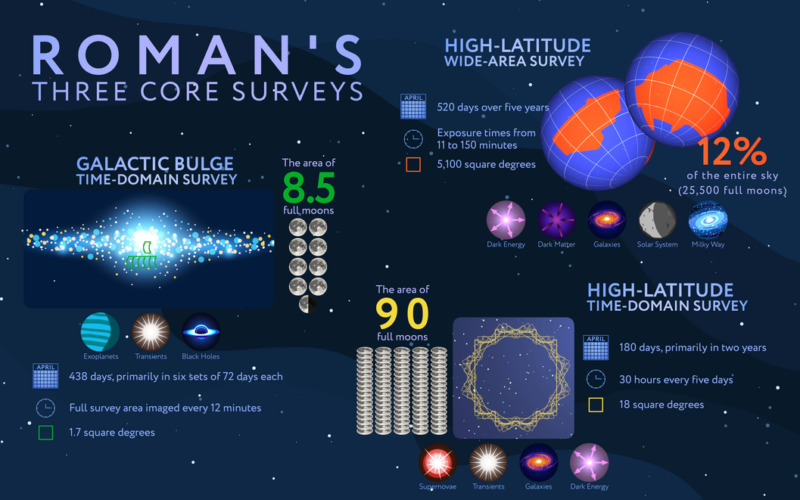
Using 18-4K x 4K sensors, the Roman Space Telescopes has a 300 mega pixel equivalent camera. It will offer a field of view at least 100 times larger than Hubble’s without losing image quality. It will use that camera to study dark energy, exoplanets and infrared astrophysics.
Mission history:
In 2010, the mission that became Roman actually originated as the “Wide-Field InfraRed Survey Telescope (WFIRST). This was to have a much smaller 1.3-meter primary mirror meant for wide-field infrared imaging.
In 2012, the National Reconnaissance Office (NRO) surprised NASA with the transfer of two space-qualified 2.4-meter telescope mirrors to NASA that NRO had as surpluses. This upgraded the telescope’s mirror to the same size of the Hubble Space Telescope. With a shorter focal length, the mirror also has a much wider field of view.
In May of 2020, to honor the pioneering astronomer known as the “Mother of Hubble”, WFIRST was renamed the Nancy Grace Roman Space Telescope. As the project has evolved and concluded it has become one of few NASA flagship missions to come in ahead of schedule and under budget.
September 2021, Roman Telescope mission passes its critical design review.
October 2024, The Optical Telescope Assembly is delivered to NASA Goddard.
November 2025, Technicians assemble the inner and outer segments of telescope at NASA Goddard.
April 2025, Start of joining Grace Payload to spacecraft.
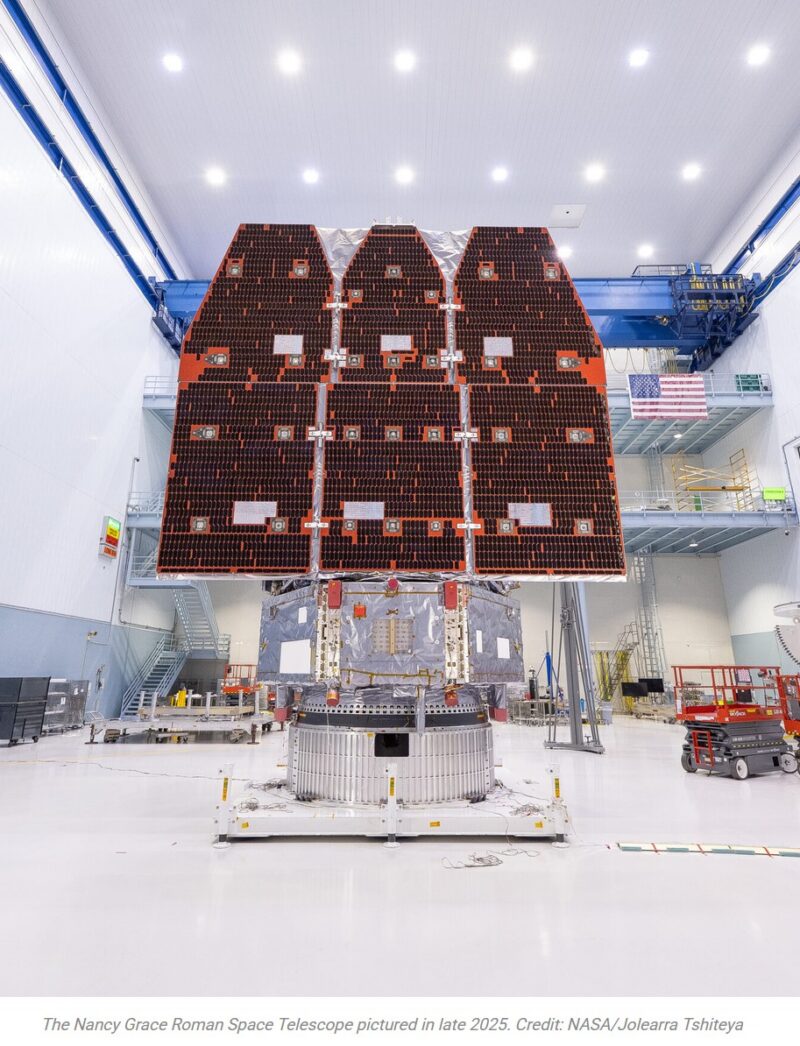
Roman left Goddard for the trip to Florida on June 12. Technical teams had completed integration and testing on the observatory at Goddard. They loaded the 18,000-pound spacecraft into a protective environmentally controlled transportation container. The container was taken to the Port of Baltimore and loaded onto the NASA Pegasus barge for the trip down the Eastern Seaboard. After a short stop in Virginia to upgrade the climate control system, the cargo was safely transported to Florida and arrived at the LC-39 Turning Basin/Barge terminal Facility at the Kennedy Space Center.
Following Roman’s arrival, the telescope was unloaded from Pegasus. The telescope was moved to the newly upgraded Payload Hazardous Servicing Facility for a post transport examination. Technicians powered up the observatory to perform system checks, ensuring the telescope was operating correctly following its arrival at KSC.
On July 25, operations were completed that included loading 290 gallons of hydrazine fuel into the observatory. Roman will use this propellant to power thrusters for 2 possible mid-course corrections. The remaining fuel will be used to maintain its planned orbit around L2 and ensure the solar array panels face the Sun. This will require a small burn about every 28 days. Roman carries enough fuel to support a 5 year mission and an additional five year extended mission. There is also a grapple fixture and fueling connections that may enable possible future refueling while on orbit at L2. The 6-7′ by 10′ solar panels are designated the Solar Array Sun Shield, and were designed and built at Goddard. They will be the observatory’s main source of power throughout its’ five-year primary mission.
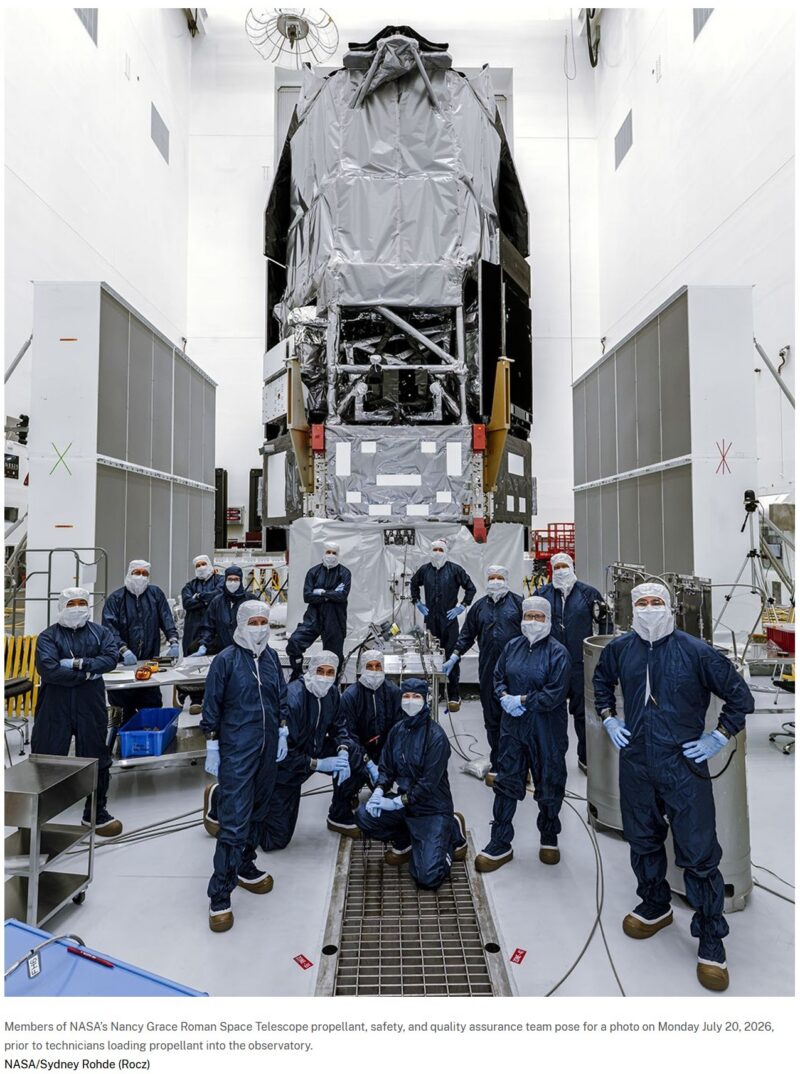
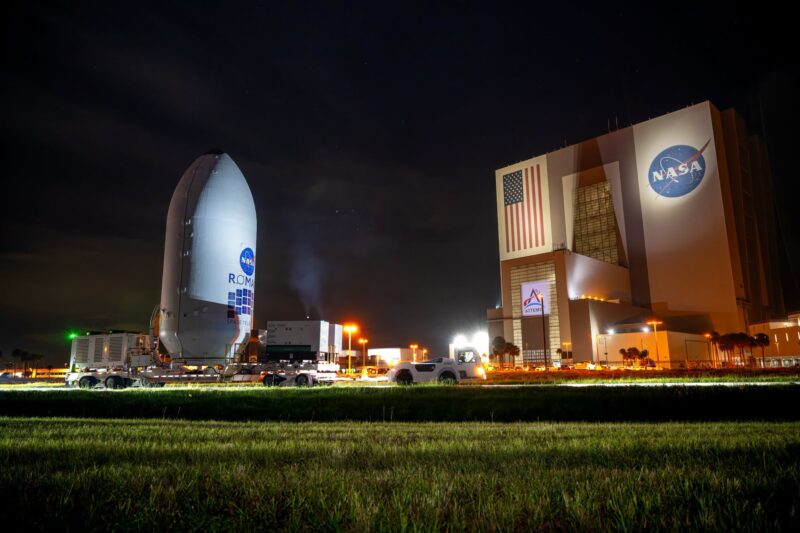
On August 21 Nancy Grace Roman Space Telescope was ready for encapsulation in the SpaceX fairing. The fairing encloses the spacecraft and they are eventually mounted atop the Falcon Heavy rocket. While still on the ground, the fairing and its ground support equipment maintain a safe, controlled environment for Roman and allow it to be transported between facilities. During launch, this two piece fairing protects Roman from acoustic vibrations, aerodynamic pressure, and atmospheric heating. A few minutes into the flight, once conditions are safe, the fairing separate and return to Earth and be recovered by SpaceX recovery ships.
After encapsulation, the satellite traveled from the Payload Hazardous Servicing Facility. It was headed to the SpaceX hanger at Pad 39A. There, it would be mated with the Falcon Heavy booster in preparation for launch.
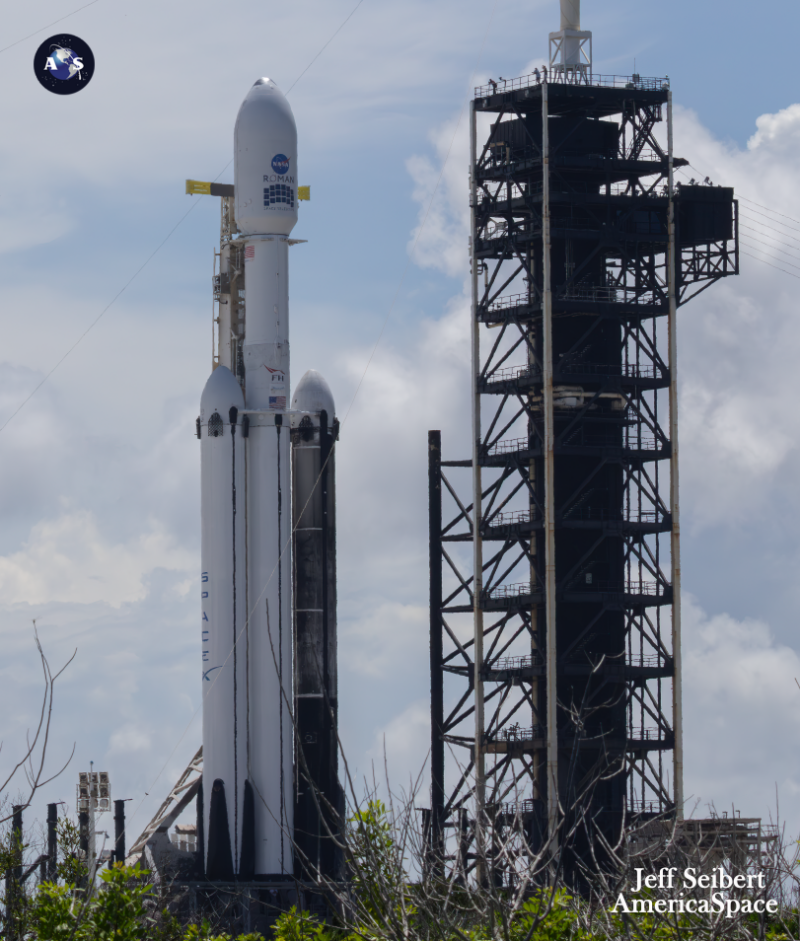
On August 29, the stacked rocket was rolled up the hill to Pad 39A, where it would would wait for launch the following day.
Launch day came with a 50% chance of weather delaying the instantaneous launch, but no onshore weather disturbances appeared. Launch took place at 7:26 AM EDT on August 30, 2026 to start an approximately 100 day trip to L2 for the Nancy Grace Roman Space Telescope.
Excellent article, Jeff. An exciting mission of exploration underway. Hope you are well.
My best,
Ben
Excellent article, Jeff. An exciting mission of exploration underway. Hope you are well.
My best,
Ben